
Relocated Charts Explained: How Moving Changes Your Birth Chart


- Your birth chart is a snapshot of the sky when you were born. A relocated chart is the same snapshot, redrawn for a different city.
- Your planets stay put. What changes is which planets sit on the key points of the chart, and which area of life they land in.
- A map shows you where to look. A relocated chart shows what living there is likely to ask of you.
- It shows themes, not guarantees.
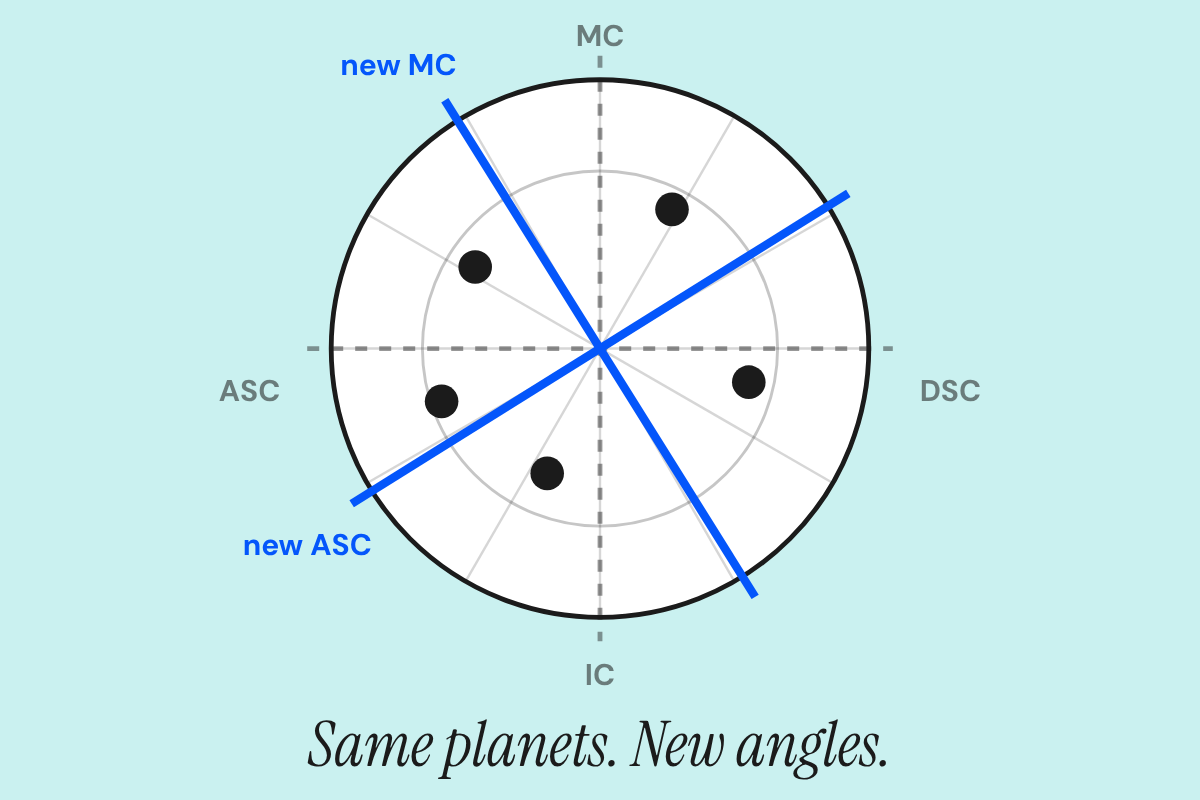
Let’s be honest. Most of us open an astrocartography map, spot a line through a city we love, and start looking at flights. The map is a good start, but it only tells you where a planet is loudest.
What it can’t tell you is what that city would actually be like for you. That’s the job of a relocated chart, also called a relocation chart, and it’s easier to understand than it sounds.
What is a relocated chart?
Your birth chart is a picture of the sky at the moment and place you were born. A relocated chart is the same picture, redrawn for a different place.
Same moment. Same planets. Different city. The planets haven’t moved, but the horizon and the sky overhead have, so the chart gets re-angled. Same cast, different stage.
| Tool | The question it answers |
|---|---|
| Astrocartography map | Where in the world is this planet loudest? |
| Relocated chart | What is my whole chart like if I live there? |
Use the map to shortlist places. Use the relocated chart to read the ones you’re serious about.
The map shortlists. The chart reads.
What changes, and what doesn’t
A quick word on houses first. They’re the twelve areas of life in a chart: money, home, work, relationships and so on.
| Changes when you move | Stays the same forever |
|---|---|
| Your houses | Which sign each planet is in |
| Which planets sit on the key points | The links between your planets |
| Which house each planet lands in | How strong or shaky each planet is |
| The signs on the key points | Your birth chart itself |
So your Venus doesn’t get better or worse in a new city. What changes is whether Venus is standing at the front door.
If you ever hear that someone’s aspects changed when they moved, something has gone wrong. Only the houses move.
The four key points, in plain English
Every chart has four key points called angles. They’re the most powerful spots in the chart, so any planet near one gets loud.
| Angle | What it covers |
|---|---|
| Ascendant | How you come across and show up. Also called your rising sign. |
| Midheaven | Career and reputation. |
| Descendant | Partnerships and close relationships. |
| IC | Home, family and roots. |
Move cities and these four points shift, so different planets end up on them. That’s how a new place can bring different parts of you forward.
How to read a relocated chart in three steps
- Look at what’s close to the four angles. A planet can connect to an angle by sitting right on it or by making a supportive or tense link to it. Right on top, within about 1 degree, is the loudest. Looser links, within about 3 degrees, are quieter.
- See which houses the planets land in. That tells you which area of life gets the spotlight: work, home, money or relationships.
- Check how each planet is doing in your birth chart. A planet arrives in the state it’s already in. A planet that’s comfortable in your chart behaves very differently from one that’s struggling.
Several signs pointing the same way is a strong signal. One lone sign is interesting, but not decisive.
The catch: planets bring their baggage
Here’s the part most beginners miss. The links between your planets never change, so a planet that lands on an angle brings its whole friend group with it.
Say someone has Venus tied to Pluto in their birth chart. Venus is love, Pluto is intensity and control. You send them to a Venus line for romance, and the line does what it says: relationships move to the front. But their Venus has always come with Pluto attached, so what shows up isn’t easier love. It’s more of the pattern they already have, and harder to dodge.
The line didn’t cause it. It took away the other options.
So before you chase a line, ask what that planet is attached to in your chart. A few pairs are worth checking first:
| If your chart has | Watch for |
|---|---|
| Mercury linked to Neptune | Paperwork going wrong: contracts misread, visas misfiled. The one to check before any move abroad. |
| Jupiter linked to Neptune | Big promises that turn out smaller than they sounded. Check the numbers on any investment. |
| Sun linked to Saturn | Recognition that comes late. Often steadier if you stay. |
Harder isn’t the same as bad. Tension gets noticed and worked on. An easy link can slide by unnoticed, which is why a smooth link to a shaky planet isn’t always good news.
When a relocated chart matters
A relocated chart matters most where you live, work, have close family, or spend extended time. A long weekend doesn’t count.
It also needs a reliable birth time. The four angles depend on it, so even a twenty-minute error can shift one by several degrees. A birth certificate is the best source. Software also needs the right time zone and daylight saving rule for where you were born, in the year you were born.
And remember what it is. A relocated chart shows what a place will ask of you, not what will happen. A hard link is a reason to be organised, not a reason to be afraid.
It’s also one input. Income, visas, climate, language and family count as much as any chart. If you’d like a relocated chart read for you, you can book a reading.
Find your cities
The AstroNat travel app shows where your lines fall and which places are worth a closer look, with 3 free city readings.
Open The Travel App →Relocated chart FAQ
What’s a natal chart?
Your birth chart: a snapshot of the sky at the moment and place you were born.
Is a relocated chart the same as a relocation chart?
Yes. Both terms mean your birth chart recalculated for a new location.
Does my Sun sign change if I move?
No. Your planets stay in the same signs wherever you go. Only the houses and the four angles change.
Do I need an exact birth time?
You need the best one you can get. The angles depend on it, so a twenty-minute error can shift one by several degrees. A birth certificate is the strongest source.
What’s the difference between astrocartography and a relocated chart?
Astrocartography maps where each planet is strongest across the whole world. A relocated chart is the full chart for one place. Use the map to shortlist and the chart to read. New to the map? Start with what the lines on your astrocartography map mean.
Can a relocated chart tell me a city will be bad for me?
No. It shows what a place will ask of you and what to prepare before you go. It doesn’t predict what will happen.
Further reading: Pottenger & Dobyns, Planets on the Move.

I'm Natalia, a locational astrologer
Book a reading →