


1. Start with what you want, not where
Most people start with a city they've already fallen for and look for reasons to justify it. Flip it around. Write down the one or two things you most want from your next move. More money? A relationship? Rest? A fresh start?
Then ask the practical questions first. Can you earn a living there? Can you get a visa? How far is it from the people you love? Astrology is one tool, not the only one.
2. Match your goal to the right planets
Each goal has its own planets. Here's a simple version:
One more check before you get excited. Look at the condition of that planet in your birth chart. If it's in a sign where it struggles, or it's the focal point of a T-square, it won't deliver easy results.
“Be realistic with your priorities and find the place that fits those best.”
3. A trine can beat being right on the line
It sounds backwards, but being exactly on a line is the most intense version of that planet. A lot of people find it overwhelming. A trine or sextile from that planet to your angles is often easier to actually live with.
There's one exception. For sport and competitive business, squares to your angles can work well, because the tension drives you to perform.
4. Shortlist, then read the relocated chart
Use the map to shortlist a few cities. Then look at the relocated chart for each one, in this order:
- Planets aspecting your new angles. These carry the most weight.
- House rulers aspecting your angles. They tell you which part of life gets activated.
- Where your Ascendant and Midheaven rulers land.
- Which houses your planets fall into.
- The signs on your new angles. A flavour, never the headline.
Then count. Three signs pointing the same way? Pay attention. Just one? Interesting, but don't sign a lease over it. Signals pulling in different directions means a mixed experience, so work out which theme wins.
Already picked the city and now choosing a neighbourhood to buy in? The AstroNat Home Finder uses Local Space to rank the best areas in town for you, or for you and your partner. To see the same idea inside your own home, read how local space lines run through your rooms.
5. Check the timing
Even the right city has better and worse years. I look at your solar and lunar returns cast for the new city, your profection year, and transits to your relocated angles. When a few of these agree on the same window, that's usually the time to go.
Don't forget the practical stuff: income, visas, family, climate and language. A relocated chart won't show any of that.
When your map says nothing at all
Sometimes a city just doesn't light up. No big lines, no strong contacts, nothing on timing. That's a real answer too. It means the decision is about your life, not your astrology, and you're free to choose on practical grounds.
New to your map? Start with what the lines on your astrocartography map actually mean. Can't move right now? Read how to use your astrocartography from home.
Choosing where home goes on your map? See where home sits on your astrocartography map. Working from anywhere? Read astrocartography for digital nomads and remote workers.
Find your best places
Compare the cities you're considering against your chart, with 3 free city readings in the AstroNat app.
Get your 3 free readings →Questions people ask
How do I find the best place to live with astrology?
Start with your goal, match it to the right planets, shortlist cities on your astrocartography map, read the relocated chart for each, then check timing.
Which planet is best for relocation?
It depends on your goal. Venus and Juno for love, Jupiter, Sun, Saturn and Pluto for career, the Moon and Ceres for home. The planet also needs to be in good condition in your birth chart.
Is it better to be right on a line?
Not always. Being exactly on a line is the most intense version of that planet. A trine or sextile to your angles is often easier to live with.
What is a relocated chart?
Your birth chart recalculated for a new city, using the same birth moment. Your houses and angles change, but your planets' signs and aspects stay the same.
What if my map doesn't show anything for a city?
That's a real answer. It means the city isn't strongly marked for you astrologically, so you can decide on practical grounds.
Further reading: Jim Lewis & Ariel Guttman, The Astro*Carto*Graphy Book of Maps (1989).

What Venus does on each angle
Most people hope their Venus line will bring love. Sometimes it does. But the angle Venus is on decides where you feel it most: in yourself, in your relationships, in your work or at home.
💗 Venus rising (ASC)
On this line, Venus affects you first. You feel more attractive and relaxed, people are friendlier to you, and day-to-day life feels more enjoyable.
You might notice more compliments, take more care with how you dress, and find dating easier than it was at home.
The downside is that it's easy to overdo the nice things, like eating, drinking or spending more than you planned.
💍 Venus setting (DSC)
On this line, Venus comes to you through other people, like partners, clients and people you work with. It's a good line for warm, comfortable relationships.
You might meet a partner who is very generous with you, or a client who stays with you for years and brings in a big part of your income.
The risk is relying on one person for everything. If they bring all the love, money and comfort, they also hold a lot of power over you. I explain more about this below.
💼 Venus Midheaven (MC)
On this line, people like working with you, and that helps your career. It's good for money, art, beauty and any job where you deal with clients.
If you're a designer, stylist or makeup artist, you may find you get more bookings here without having to work as hard to find them.
The downside is that you can get too comfortable. The income is good and the clients are nice, so you stop pushing. That's fine if you want an easier life, but not if you moved there to grow your career.
🛋️ Venus IC (home)
On this line, Venus shows up in your home and family life. You're more likely to find a home you really love, enjoy having people over, and get on better with family.
It's a lovely line for settling down. Just make sure you still get out of the house.
Real love: when your Venus line works
A Venus line tends to bring healthy love when:
- Your Venus is in a comfortable sign. It's strongest in Taurus and Libra (home) and Pisces (exalted). It struggles in Scorpio and Aries (detriment) and Virgo (fall).
- Venus makes a trine or sextile to your angles rather than sitting exactly on one. These softer contacts are often easier to enjoy than an exact line.
- Juno, the asteroid of committed partnership, is supporting it. Juno on your angles is a classic signal for marriage and long-term relationships.
- The ruler of your 7th house connects to your angles, or Venus, Juno or your 7th ruler land in your relocated 7th house.
For example, if your Venus is in Taurus and trines Jupiter, your Venus line is likely to feel steady and generous. Relationships there tend to grow slowly and last, rather than starting fast and ending fast.
“A Venus line will reveal how much you think you're worth.”
Toxic love: when Venus brings the wrong planets
Whatever planets Venus aspects in your birth chart tag along onto the line. These are the ones to watch:
- Venus–Pluto: relationships at full volume. Jealousy, power imbalance, partners who want to merge money or identity fast, a pull that feels like fate.
- Venus–Saturn: love tied to duty or scarcity. Age or status gaps, long distance, not feeling chosen. The softer version can give a loyal, long marriage.
- Venus–Neptune: meeting someone who isn't who you think they are. Idealising, rescuing, or money draining into other people.
- Venus–Uranus: sudden starts and sudden endings. Partners who are unavailable and call it freedom.
- Venus–Mars: fast attraction, and conflict as a love language.
Here's how that looks on the same Venus Descendant line. If your Venus squares Pluto, you might meet someone you feel very drawn to, but who also wants to control where you go and who you see. If your Venus squares Saturn, you're more likely to meet someone older, or to start with a long-distance relationship before things get easier.
And here's the tricky part. A trine or sextile between those planets doesn't make it safe. It just makes the pattern feel like chemistry, so nobody questions it for years.
Why your Venus Descendant line isn't a dating app
Here's the catch with the Descendant. Planets there are often projected onto other people. In other words, instead of feeling more beautiful or relaxed yourself, you may keep meeting partners who carry all the Venus energy for you.
That can be lovely. It can also mean you hand over your own sense of worth, money or pleasure to whoever you're dating. The healthiest way to use a Venus DC line is to keep some of that Venus for yourself.
Venus for money and creative work
Venus isn't only about romance. It also works for:
- For money: Venus making a trine or sextile to your Midheaven.
- For artistic and creative work: Venus or Neptune on, or making a trine or sextile to, your Ascendant or Midheaven.
For example, a painter with Venus trine their relocated Midheaven might sell more work and get more gallery interest in that city, even if nothing changes in their love life.
So a Venus MC city might be better for your income or your art than for your love life. I wrote more about career and money lines in want fame and fortune? Try activating these astrocartography lines.
When to think twice
If your Venus is the focal point of a T-square or a grand cross in your birth chart, be careful about putting it on an angle and expecting an easy time. It's not a no. It's a reason to go in with your eyes open and good boundaries.
This is a reason to be organised, not a reason to be afraid. Nothing in a birth chart causes another person's behaviour.
Don't forget the practical stuff: income, visas, family, climate and language. A relocated chart won't show any of that.
Read next: why moving to a Jupiter or Venus line can mess you up.
Where are your Venus lines?
See where your Venus lines fall, and which planets they activate with them, with 3 free city readings in the AstroNat app.
Get your 3 free readings →Questions people ask
What does a Venus line mean in astrocartography?
A Venus line marks where Venus was on one of your four angles when you were born. Living near it puts love, pleasure, beauty and money themes in focus.
Is a Venus line good for love?
It can be, especially if your Venus is in a strong sign and well aspected. If Venus is tied to Pluto, Saturn, Neptune, Uranus or Mars, those patterns show up in love too.
What is a Venus Descendant line?
Venus on your Descendant brings love and comfort through partners. You may also project Venus onto others, meeting people who carry that energy for you.
Is a Venus line good for money?
Venus making a trine or sextile to your Midheaven is one of the classic money signals, so a Venus MC city can support income through charm and client work.
What else should I check for marriage?
Look at Juno and the ruler of your 7th house, and whether Venus, Juno or the 7th ruler land in your relocated 7th house.
Further reading: Jim Lewis & Ariel Guttman, The Astro*Carto*Graphy Book of Maps (1989).

Fame lives on your Midheaven
Your Midheaven, or MC, is the highest point of your chart. It's about career, reputation and how the public sees you. So if you want to be known for something, the planets on or aspecting your MC in a city matter most.
On your map, MC lines are the straight north–south lines. A planet on your MC line sits right at the top of your chart in that city. But a trine or sextile to your MC is often easier to work with than being exactly on the line. Being right on it is the most intense version.
The career planets
Here's what each planet tends to bring to your Midheaven:
The big ones for career: Jupiter, the Sun, Saturn and Pluto in a trine or sextile to your MC. Ceres and Vesta help too. The ruler of your 10th house connecting to your MC is another strong signal.
“The right city will support your life's calling with genuine public support and visibility.”
The money planets
Money is a different story. For money, look at:
- Venus, Jupiter and Pluto making a trine or sextile to your MC.
- The rulers of your 2nd and 8th houses (your own money, and shared money like investments, partners' income and loans) making a trine or sextile to your MC.
- Those same rulers landing in your 2nd, 8th or 10th house in the new city.
So a city can be great for money without having an obvious “money line” running through it. That's why I always read the relocated chart, not just the map.
Power and ambition
If you want authority, influence and to be taken seriously, look to a different trio: the Sun, Pluto and Saturn making a trine or sextile to your angles. It helps even more when those planets fall into your 5th, 8th, 9th, 10th or 11th houses in the new city.
Notice Saturn keeps showing up. Most people avoid their Saturn lines, but for long-term success they can be exactly what you need. I wrote more about that in should you avoid your Saturn line?
The catch
The planets on your MC bring their natal aspects with them. That's where career cities go wrong:
- Jupiter–Neptune: opportunities that sound huge and turn out smaller than described. The classic bad-investment-abroad pattern.
- Sun–Saturn: recognition comes, but late, and self-doubt shows up right where your ambition is.
- Sun–Pluto: power struggles with whoever is above you.
- Jupiter–Saturn: growth that keeps getting clawed back.
And if the planet you want on your MC is the focal point of a T-square or grand cross in your birth chart, think twice. It's unlikely to bring easy results.
Timing your big break
Even the right city has better and worse years. I look at transits to your relocated MC, your solar return cast for the new city, and your profection year. When a few of these point to the same window, that's when a move, a launch or a big pitch tends to land well.
Don't forget the practical stuff: income, visas, family, climate and language. A relocated chart won't show any of that.
New to reading your map? Start with what the lines on your astrocartography map actually mean.
Building a career from anywhere? Read astrocartography for digital nomads and remote workers.
Find your career cities
See which cities light up your Midheaven, and which planets they activate with it, with 3 free city readings in the AstroNat app.
Get your 3 free readings →Questions people ask
Which astrocartography line is best for fame?
Fame and reputation are linked to your Midheaven (MC). The Sun, Jupiter, Saturn and Pluto making a trine or sextile to your MC are the strongest career signals.
Which astrocartography line is best for money?
Venus, Jupiter and Pluto making a trine or sextile to your MC, and the rulers of your 2nd and 8th houses connecting to your MC.
Is a Jupiter MC line good for career?
It can bring growth and bigger opportunities, but it amplifies the Jupiter in your birth chart. A Jupiter tied to Neptune or Saturn can bring overpromising or growth that doesn't stick.
Do I need to be exactly on an MC line?
No. A trine or sextile to your MC is often easier to work with than being exactly on the line, which is the most intense version.
Can astrocartography make me famous?
No line guarantees fame. The right city puts career and reputation themes in focus, but you still have to do the work.
Further reading: Jim Lewis & Ariel Guttman, The Astro*Carto*Graphy Book of Maps (1989).

Visas, money, family: most people can't just move
A lot of astrocartography content assumes you can live anywhere. Real life isn't like that. Maybe your passport limits where you can work. Maybe you're caring for family, or you've finally got stability and don't want to throw it away for a line on a map.
That's okay. The goal isn't to move to your “best” city at all costs. It's to understand how places affect you, and to bring more of the supportive ones into your life in ways that actually fit it.
Travel and short stays on your lines
The simplest option is to visit. A holiday, a work trip or a few weeks of remote work on a line will show you how that planet feels for you, without the commitment of a move.
Short trips give you a taste. Longer stays give you more. A relocated chart matters most when you live somewhere, work there a lot, have important family there or spend long stretches of time there. So a month on your Venus line will tell you more than a weekend.
Treat it like an experiment. Notice how you sleep, how people respond to you and what kind of opportunities turn up. That's your own data, and it's worth more than any generic line description.
If you work remotely, I've written about how to pick a base and plan short stays as a digital nomad.
“You don't need to move countries to change your environment.”
Local space: the directions around you that work for you
Local space is a different technique from astrocartography. It was developed by the astrologer Michael Erlewine in the 1970s and expanded by Steve Cozzi in his 1988 book Planets in Locality.
Instead of asking where in the world a planet is strongest, it asks which direction each planet sits in from where you are. Every planet gets a compass bearing from your birthplace, or from the city you live in now.

A few practical ways people use it:
- Choosing a direction to move. Cozzi taught that the direction you travel in matters, not just where you land. Moving along your Jupiter direction is a Jupiter move, even to a city with no big lines on your map.
- Choosing a neighbourhood. Within your own city, you can look at which planets sit in each direction from your current home.
- Setting up your home. Martin Davis describes standing in your main doorway, taking a compass bearing and reading it against your local space chart. Some people use this for where to put a desk or a bed.
Erlewine's own story is a good example. He moved from Lancaster, Pennsylvania to Ann Arbor, Michigan along his Jupiter direction, and that's where he found his life's work.
One limit to know. According to Davis, local space works as a chart up to roughly 50 miles from where you are. Beyond that, you read the directions as lines on a world map instead.
You can find your supportive directions around your home with the AstroNat Home Finder.
Want to try it on your own floor plan? Here's how to read the local space lines running through your home.
Remote activation, explained simply
Remote activation means working with a place's planetary themes without living there. That can include its culture, its people, its timing and the things it's known for.
Some real-world examples:
- Work with clients, teams or companies based on your good lines. If your Jupiter MC line runs through Sydney, building connections there can bring some of that energy into your career.
- Learn the language or culture of a city on a supportive line, and connect with people from there.
- Plan your trips around good timing, so the visits you can make count for more.
It won't feel as strong as living on the line, and it isn't an instant fix. But it's a practical way to bring more of a supportive place into your everyday life.
Timing: when a place becomes active for you
Your astrocartography map never changes, but the planets in the sky keep moving. Jim Lewis, who created astrocartography, developed a timing method for this called Cyclo*Carto*Graphy. It plots your current transits and progressions over your map as moving lines, so you can see when a place becomes active for you.
I also look at your solar and lunar returns cast for the city you're thinking about, plus your profection year. When a few of these point to the same window, that's when a trip, a big meeting or a move tends to go more smoothly.
So even if you can't move this year, you can still choose the right time to visit, launch something with a client there, or plan for a move in a few years.
Don't forget the practical stuff: income, visas, family, climate and language. A relocated chart won't show any of that.
New to your map? Start with what the lines on your astrocartography map actually mean. Thinking about a Saturn city? Read should you avoid your Saturn line?
Find your best places
See which cities and lines suit you before you book anything, with 3 free city readings in the AstroNat app.
Get your 3 free readings →Questions people ask
Can you use astrocartography without moving?
Yes. You can visit places on your lines, use local space to work with directions around your home, connect with people and work from supportive places remotely, and plan around good timing.
What is local space astrology?
Local space shows the compass direction of each planet from where you are. It was developed by Michael Erlewine in the 1970s and expanded by Steve Cozzi. People use it to choose a direction to move, a neighbourhood or how to set up their home.
What is remote activation in astrocartography?
Remote activation means working with a place's planetary themes without living there, for example by working with clients based there, learning its language and culture, or timing your visits well.
Do short trips to my lines work?
Short trips give you a taste of a line. Longer stays, or spending a lot of time working with a place, tend to show its effects more clearly.
Does local space work inside my home?
Some astrologers use it at room scale. Martin Davis describes taking a compass bearing from your main doorway and reading it against your local space chart.
Further reading: Michael Erlewine, The Astrology of Local Space (1977); Steve Cozzi, Planets in Locality (1988); Martin Davis, From Here to There (2008).
No planet is automatically bad
This is the first rule of reading any line. A planet on an angle doesn't decide your fate. It shows you which part of your chart gets louder there, and you decide what to do with it.
Saturn is the planet of structure, time, effort and responsibility. On an angle, it asks you to grow up a bit. That can feel heavy. It can also be the exact pressure that gets you organised and taken seriously.
“Saturn rewards, but it will demand a price.”
Saturn on each angle
Remember the lines come in pairs. A Saturn IC line is also Saturn opposite your Midheaven, so home duties can pull against your career. A Saturn DC line is also Saturn opposite your Ascendant, so other people's expectations can weigh on you.
When a Saturn line is actually a good idea
Saturn's actually great for three things:
- Career success, especially when Saturn makes a trine or sextile to your Midheaven.
- Focus and getting organised, when you need discipline more than inspiration.
- Power and ambition, when you want authority and to be taken seriously.
So if you're moving to build a company, qualify in a demanding profession or finally commit to a long-term plan, a Saturn city can work in your favour. If you're moving to rest, heal or have the year of your life, it probably won't.
One more thing. A softer contact, like Saturn trine or sextile your angle, tends to give you Saturn's structure without the full weight. Sitting exactly on the line is the most intense version.
What makes it heavier or lighter
Two Saturn lines can feel completely different, depending on your birth chart.
The sign Saturn is in. Saturn is strongest in Capricorn and Aquarius (home) and Libra (exalted). It struggles in Cancer and Leo (detriment) and Aries (fall). A dignified Saturn tends to bring discipline that pays off. A struggling one tends to bring more of the frustration.
Day or night birth. Saturn tends to behave better in a day chart, when you were born with the Sun above the horizon. In a night chart, its harder side usually shows more.
The planets it aspects. Whatever planets Saturn aspects in your birth chart tag along onto the line. For example:
- Sun–Saturn: recognition comes late, and self-doubt shows up right where your ambition is. Bites hardest on the MC.
- Moon–Saturn: loneliness or emotional rationing at home. Bites hardest on the IC.
- Mars–Saturn: effort that grinds, and more risk of injury in physical work. Bites hardest on the AC.
- Venus–Saturn: love tied to duty, distance or not feeling chosen. Bites hardest on the DC.
A hard aspect like a square isn't always worse, either. You feel the tension, so you deal with it. Easy aspects can let Saturn's heavier side settle in without you noticing.
Timing matters too
Your map is fixed, but the planets in the sky keep moving. If transiting Jupiter is crossing your Saturn line the year you arrive, that heavy city might open doors faster than expected. If transiting Saturn is hitting your relocated angles at the same time, expect a slower, tougher start.
That's why I check your solar and lunar returns cast for the new city, plus your profection year, before I recommend a move. Same place, different year, very different experience.
How to live on a Saturn line and do well
If you're already there, or the Saturn city is the one you really want, set yourself up properly:
- Give it time. Saturn rewards patience and dedication. It is the planet of time after all. Judge it after a couple of years, not three months.
- Build structure early. Routines, savings, clear contracts and a realistic plan.
- Find your people. Saturn places can feel lonely, so make the effort to build a support network.
- Look after your body. Rest, strength and boundaries around work, especially on a Saturn AC line.
This is a reason to be organised, not a reason to be afraid.
Don't forget the practical stuff: income, visas, family, climate and language. A relocated chart won't show any of that.
If you're new to reading your map, start with what the lines on your astrocartography map actually mean. And if you're weighing up a Jupiter or Venus city instead, read why moving to a Jupiter or Venus line can mess you up.
Thinking about Saturn at home? Start with where home sits on your astrocartography map.
Where are your Saturn lines?
See where your Saturn lines fall, and which planets they activate with them, with 3 free city readings in the AstroNat app.
Get your 3 free readings →Questions people ask
Is a Saturn line bad in astrocartography?
Not automatically. A Saturn line brings structure, responsibility and slow, earned results. It can be very good for long-term career goals and tough if you're looking for an easy, carefree time.
What does a Saturn MC line mean?
Saturn on your Midheaven brings authority and a career built over time. Recognition usually comes slowly and is earned, often with a lot of pressure and responsibility along the way.
Is a Saturn line good for career?
It can be, especially if Saturn is in a strong sign in your birth chart or makes a trine or sextile to your Midheaven in the new city. It suits people who want to build something that lasts.
Should I move to my Saturn line?
It depends on your goal, the condition of your Saturn, the planets it aspects and your timing. Read the full relocated chart for that city before deciding.
How long does it take to feel settled on a Saturn line?
Saturn works slowly. Many people find the first year the hardest, so give it at least a couple of years before you judge it.
Further reading: Jim Lewis & Ariel Guttman, The Astro*Carto*Graphy Book of Maps (1989); Erin Sullivan, Where in the World? (1999).

Your map is your birth chart, stretched over the globe
Astrocartography (officially Astro*Carto*Graphy) was developed by the American astrologer Jim Lewis in the 1970s. The idea is simple. At the moment you were born, every planet was rising, setting, overhead or underneath somewhere on Earth. Your map draws a line through every place where that was exactly true.
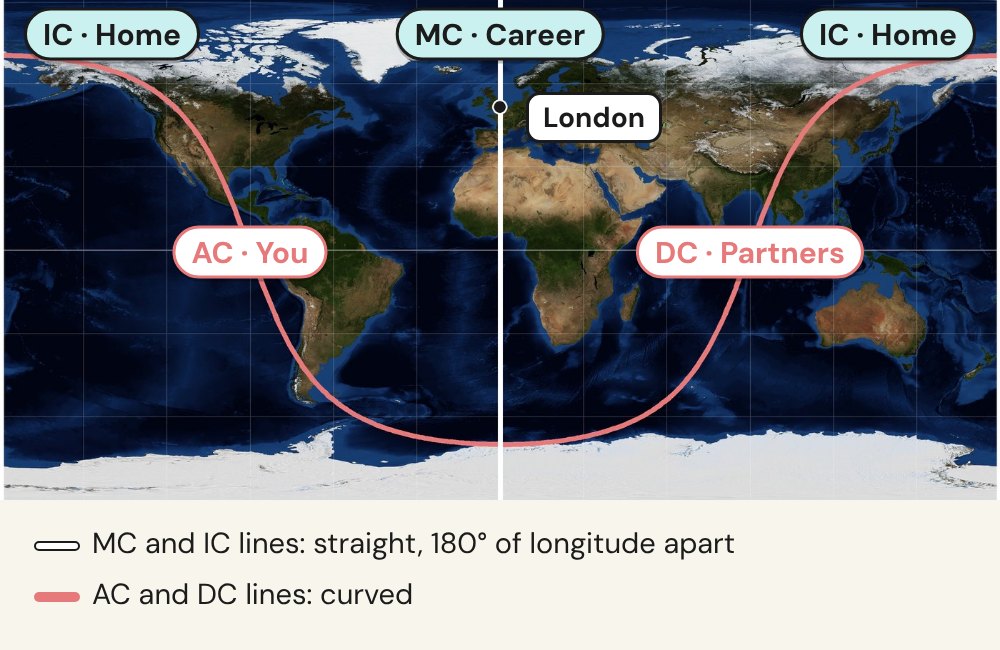
So each line is one planet sitting on one of the four angles of your chart. With ten planets (counting the Sun and Moon) and four angles, that's 40 lines. Some maps add extras like Chiron or the lunar nodes, which is why yours might look busier.
Nothing about you changes when you move. Your planets stay in the same signs, making the same aspects to each other. What changes is which planets sit on your angles, and those are the ones you'll feel the most.
The four main astrocartography lines
The lines come in pairs. A planet on your Descendant is also opposite your Ascendant, and a planet on your IC is also opposite your Midheaven. So a Saturn IC line isn't just about home. It's also Saturn pulling against everything your Midheaven stands for, like career and visibility.
Rising and setting lines curve because of how the horizon tilts at different latitudes. Midheaven and IC lines are straight because they follow the meridian, the line running from north to south directly above you.
Looking for home specifically? Start with where home sits on your astrocartography map.
“Your chart follows you, but the way it expresses itself differs by location.”
How close do you need to be to feel a line?
Astrologers disagree on this, and the sources use different distances. Here's the rule I work by:
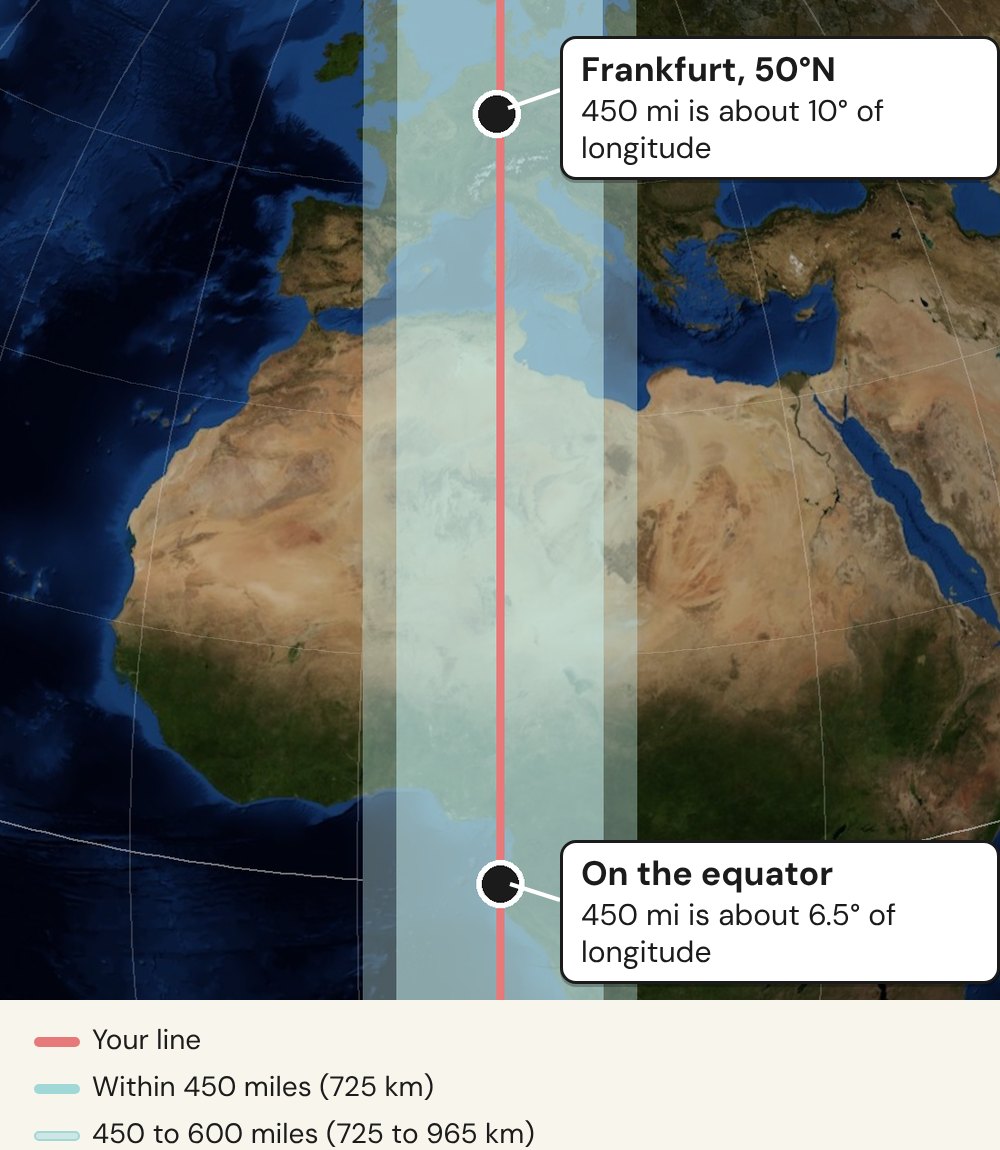
- Within about 450 miles (725 km): you're in the line's reach. Expect to feel that planet.
- 450 to 600 miles (725 to 965 km): the edge of its influence. Noticeable, but milder.
- Further than that: I'll tell you honestly that the line probably isn't doing much for you there.
One catch most people miss. Work in miles, not degrees, because a degree of longitude shrinks as you move toward the poles. It's about 69 miles (111 km) at the equator but only about 44 miles (71 km) at 50° north, around London or Frankfurt.
And closer isn't automatically better. Sitting exactly on a line is the most intense version of that planet, which can be a lot to live with every day.
Where lines cross: parans
Sometimes two lines cross on your map. These crossings are called parans, short for paranatellonta, meaning “rising side by side”. It means two planets are angular at the same time.
Here's the bit people miss. A paran doesn't just affect the exact crossing point. Its effect runs around the whole world along that line of latitude. So a crossing over the Atlantic can still matter for a city at the same latitude in Asia.
A simple way to think about it: a line describes what a place is like for you. A crossing describes what that place asks you to do.
What your map can't tell you
The map is brilliant for shortlisting cities. But it leaves out a lot:
- The condition of the planet. A Jupiter in a sign where it struggles still struggles on its line.
- What the planet brings with it. Every aspect that planet makes in your birth chart comes along too.
- Softer contacts. Maps only draw planets exactly on an angle. Squares, trines and sextiles to your angles don't show up at all.
- Your houses. Which part of your life each planet lands in, which is where a lot of the detail is.
That's why someone can be hundreds of kilometres from every line on their map and still have a very eventful time in a city. I wrote about how this catches people out in why moving to a Jupiter or Venus line can mess you up.
The map also can't zoom in to your street or your rooms. For that, there's local space astrology and the planetary lines running through your home.
Your relocated chart shows how your planets play out in different houses
A relocated chart is your birth chart recalculated for a new city, using the same birth moment. Your houses and angles shift. Your planets' signs and aspects stay the same. It's the full picture behind every line on your map.
When I read a place for a client, I look at it in this order:
- Planets on your new angles. These matter most.
- The planets that rule your houses, and whether they're hitting those angles.
- Where your Ascendant and Midheaven rulers land.
- Which houses your planets fall into in the new city.
- The signs on your new angles. These add flavour, but they're never the headline.
And don't forget the practical stuff: income, visas, family, climate and language. A relocated chart won't show any of that.
See your lines in minutes
Pop in your birth details and see which lines run closest to the cities you're thinking about, with 3 free city readings in the AstroNat app.
Get your 3 free readings →Questions people ask
What do the lines on an astrocartography map mean?
Each line marks every place where one of your planets was exactly rising (AC), setting (DC), overhead (MC) or underfoot (IC) at the moment you were born. Living near a line makes that planet more noticeable in your life.
Why are some lines curved and others straight?
Midheaven and IC lines follow the north–south meridian, so they're straight. Rising and setting lines follow the horizon, which tilts differently at each latitude, so they curve.
How close do I need to be to a line?
Main lines are felt roughly 450 to 600 miles (725 to 965 km) either side, and closer is stronger. Measure in miles rather than degrees, because a degree of longitude gets shorter toward the poles.
Who invented astrocartography?
The American astrologer Jim Lewis developed Astro*Carto*Graphy in the 1970s. He also created a timing method for it called Cyclo*Carto*Graphy.
Is astrocartography the same as a relocated chart?
No. The map shows where each planet is strongest around the world. A relocated chart recalculates your whole birth chart for one city, so it shows what living there is actually like, including aspects and houses the map leaves out.
Further reading: Jim Lewis & Ariel Guttman, The Astro*Carto*Graphy Book of Maps (1989); Erin Sullivan, Where in the World? (1999); Martin Davis, Astrolocality Astrology (1999).