


What is geodetic astrology?
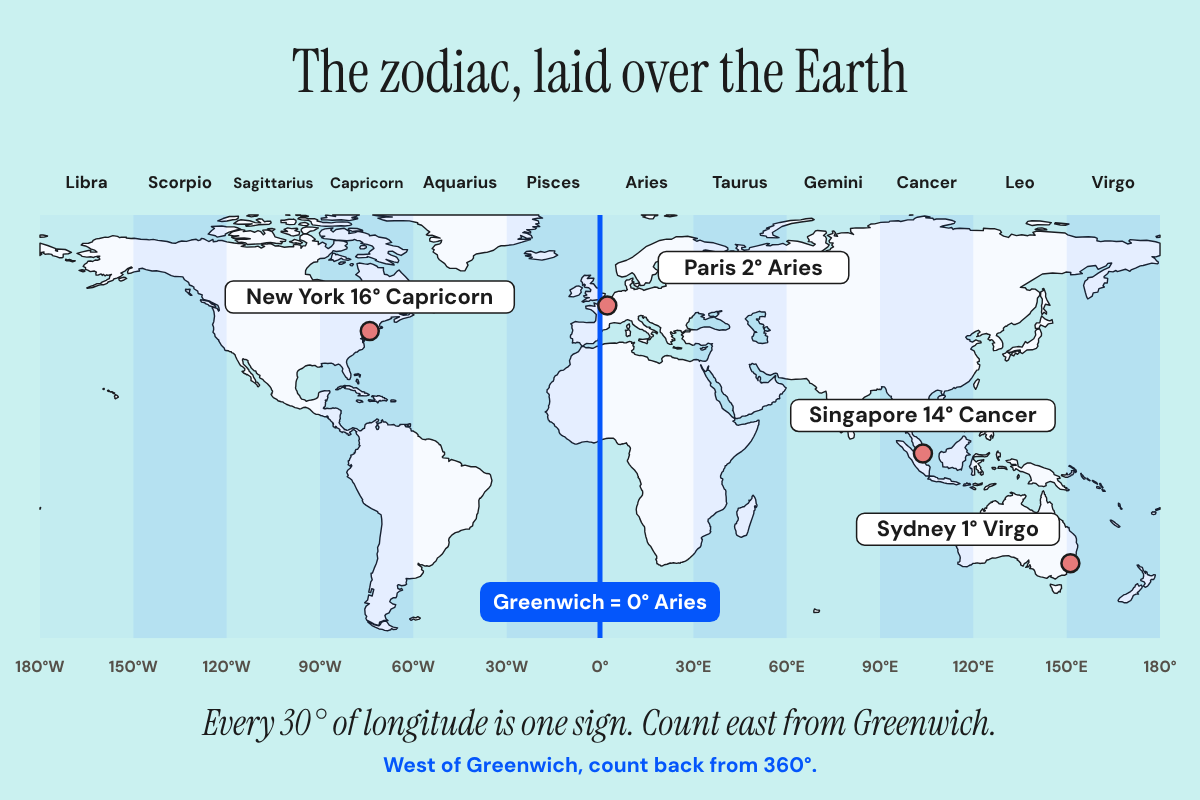
Geodetic astrology lays the zodiac over the Earth. The British astrologer Sepharial, whose real name was Walter Gorn Old, set out the method in his 1925 book The Theory of Geodetic Equivalents.
The rule is simple:
- The Greenwich meridian (0° longitude) is 0° Aries.
- You count east from there. Every 30° of longitude is one zodiac sign.
- For places west of Greenwich, you subtract the longitude from 360°.
So every place gets its own zodiac degree, and that degree never changes. It’s tied to the place, not to a person.
| Place | Longitude | Geodetic degree |
|---|---|---|
| Greenwich | 0° | 0° Aries |
| Paris | 2°E | 2° Aries |
| Singapore | 104°E | 14° Cancer |
| Ubud, Bali | 115°E | 25° Cancer |
| Tokyo | 140°E | 20° Leo |
| Sydney | 151°E | 1° Virgo |
| New York | 74°W | 16° Capricorn |
| Los Angeles | 118°W | 2° Sagittarius |
Rounded to the nearest degree.
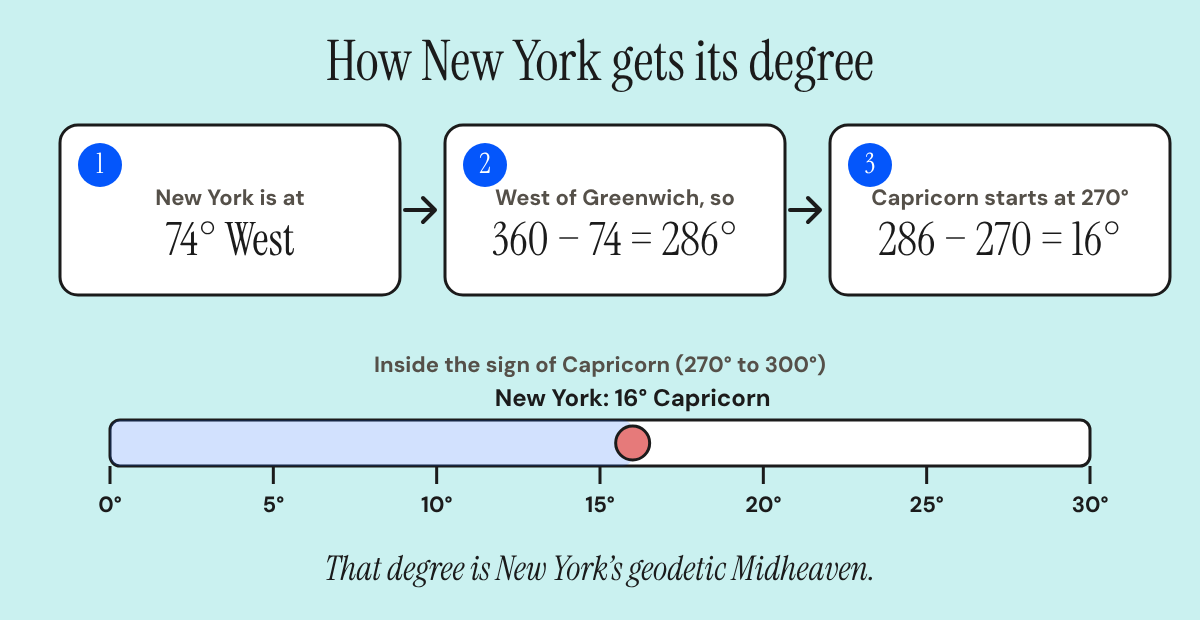
That degree is the place’s geodetic Midheaven. A full geodetic chart then works out an Ascendant for the place’s latitude, the same way any chart does.
The big difference: the place or you
This is the part to remember.
| Geodetic astrology | Astrocartography | |
|---|---|---|
| Starts from | The Earth’s coordinates | Your birth chart |
| Needs your birth details? | No | Yes |
| Same for everyone? | Yes. A city’s geodetic chart is fixed | No. Your map is only yours |
| The question it answers | What is this place like? | What is this place like for me? |
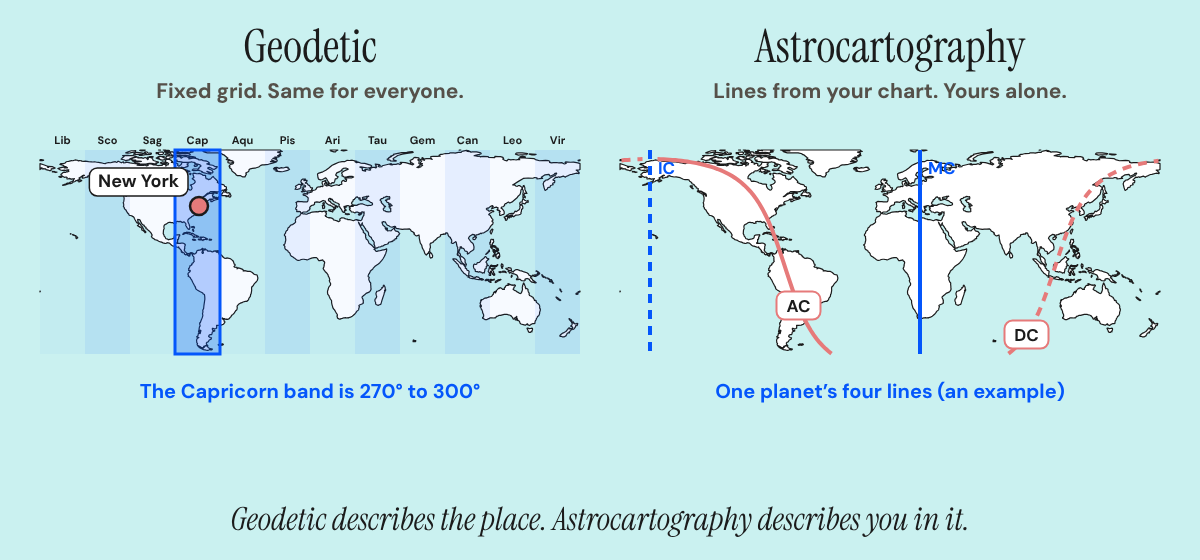
Geodetic is the baseline of a place. Astrocartography is how your own chart meets it. Jim Lewis developed astrocartography, and it plots every spot on Earth where each of your planets sat on an angle at the moment you were born.
What they have in common
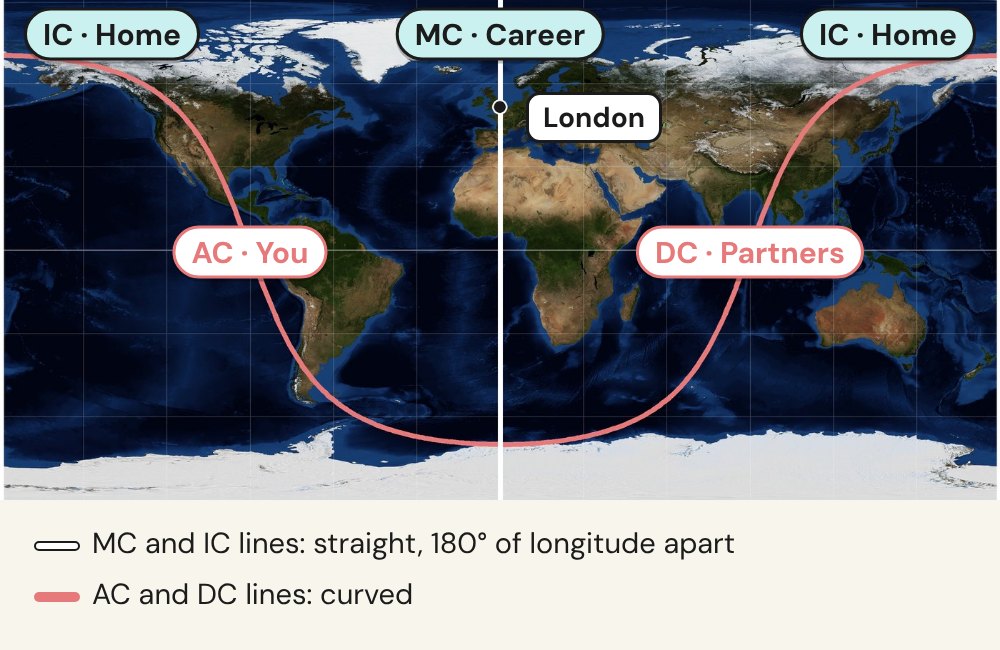
Both belong to locational astrology, the branch of astrology that reads places. Both use the four angles. And on both maps, the Midheaven shows up as a straight north to south line.
But the lines don’t mean the same thing. On your astrocartography map, a Midheaven line is where one of your planets was at the top of the sky. On a geodetic map, a Midheaven line is where the zodiac degree for that longitude sits. They can fall in the same place, but they’re answering different questions.
It’s older than 1925
Geodetic astrology didn’t come out of nowhere. Medieval astrologers already tied signs to regions. Abu Ma’shar, for example, wrote that a planet’s effect shows up in the cities that fall under a sign’s part of the world (see Dykes, Astrology of the World II).
Sepharial’s step was to make the link exact. Instead of broad regions, every degree of longitude gets a zodiac degree.
How to use them together
Here’s a simple way to combine them.
- Start with your astrocartography map. Use it to shortlist places where your planets are strong.
- Look up each city’s geodetic degree. Then see whether any of your natal planets sit close to it. Astrologers who use geodetic read that as the place and the person lining up.
- Finish with a relocated chart. That’s still the actual reading for a city. Here’s what a relocated chart is.
Say you have Venus at 14° Cancer. Singapore’s geodetic degree is also 14° Cancer, so a geodetic astrologer would flag Singapore as a place where your Venus is emphasised. It’s an extra layer on top of your map, not a replacement for it.
What to keep in mind
Geodetic systems vary. Astrologers don’t all start the count in the same place or use the same zodiac, so two geodetic maps can disagree. Check which system yours uses. The standard Sepharial version uses the tropical zodiac.
It’s also a symbolic system. It describes the themes a place carries, not what will happen to you there. Treat it as one input alongside your budget, visa, climate, language and family.
If you’d like both read for you, you can book a reading. AstroNat also uses geodetic analysis in its corporate work.
Find your cities
The AstroNat travel app shows where your lines fall and which places are worth a closer look, with 3 free city readings.
Open The Travel App →Geodetic astrology FAQ
What is geodetic astrology?
A system that matches each place on Earth to a zodiac degree, based on its longitude. It’s the same for everyone and doesn’t use a birth chart.
Who invented geodetic astrology?
Sepharial (Walter Gorn Old) set out the method in his 1925 book The Theory of Geodetic Equivalents.
Is geodetic astrology the same as astrocartography?
No. Geodetic starts from the place. Astrocartography starts from your birth chart and shows where your own planets are strongest.
Do I need my birth chart for geodetic astrology?
Not to find a place’s geodetic degree. You only need it if you want to compare your planets to that degree.
What zodiac does geodetic astrology use?
The standard Sepharial system uses the tropical zodiac, with 0° Aries at the vernal equinox.
What’s a geodetic Midheaven?
The zodiac degree that matches a place’s longitude. For New York it’s about 16° Capricorn.
Further reading: Sepharial, The Theory of Geodetic Equivalents (1925); L. Edward Johndro, The Earth in the Heavens (1929).

What is a relocated chart?
Your birth chart is a picture of the sky at the moment and place you were born. A relocated chart is the same picture, redrawn for a different place.
Same moment. Same planets. Different city. The planets haven’t moved, but the horizon and the sky overhead have, so the chart gets re-angled.
| Tool | The question it answers |
|---|---|
| Astrocartography map | Where in the world is this planet loudest? |
| Relocated chart | What is my whole chart like if I live there? |
Use the map to shortlist places. Use the relocated chart to read the ones you’re serious about.
The map points you to a city. The chart tells you what it’s like to live there.
What changes, and what doesn’t
A quick word on houses first. They’re the twelve areas of life in a chart: money, home, work, relationships and so on.
| Changes when you move | Stays the same forever |
|---|---|
| Your houses | Which sign each planet is in |
| Which planets sit on the key points | The links between your planets |
| Which house each planet lands in | How strong or shaky each planet is |
| The signs on the key points | Your birth chart itself |
So your Venus doesn’t get better or worse in a new city. What changes is whether Venus is standing at the front door.
If you ever hear that someone’s aspects changed when they moved, something has gone wrong. Only the houses move.
The four key points, in plain English
Every chart has four key points called angles. They’re the most powerful spots in the chart, so any planet near one gets loud.
| Angle | What it covers |
|---|---|
| Ascendant | How you come across and show up. Also called your rising sign. |
| Midheaven | Career and reputation. |
| Descendant | Partnerships and close relationships. |
| IC | Home, family and roots. |
Move cities and these four points shift, so different planets end up on them. That’s how a new place can bring different parts of you forward.
How to read a relocated chart in three steps
- Look at what’s close to the four angles. A planet can connect to an angle by sitting right on it or by making a supportive or tense link to it. Right on top, within about 1 degree, is the loudest. Looser links, within about 3 degrees, are quieter.
- See which houses the planets land in. That tells you which area of life gets the spotlight: work, home, money or relationships.
- Check how each planet is doing in your birth chart. A planet arrives in the state it’s already in. A planet that’s comfortable in your chart behaves very differently from one that’s struggling.
Several signs pointing the same way is a strong signal. One lone sign is interesting, but not decisive.
The catch: planets bring their baggage
Here’s the part most beginners miss. The links between your planets never change, so a planet that lands on an angle brings every planet it’s linked to along with it.
Say someone has Venus tied to Pluto in their birth chart. Venus is love, Pluto is intensity and control. You send them to a Venus line for romance, and the line does what it says: relationships move to the front. But their Venus has always come with Pluto attached, so what shows up isn’t easier love. It’s more of the pattern they already have, and harder to dodge.
The line didn’t cause it. It took away the other options.
So before you chase a line, ask what that planet is attached to in your chart. A few pairs are worth checking first:
| If your chart has | Watch for |
|---|---|
| Mercury linked to Neptune | Paperwork going wrong: contracts misread, visas misfiled. The one to check before any move abroad. |
| Jupiter linked to Neptune | Big promises that turn out smaller than they sounded. Check the numbers on any investment. |
| Sun linked to Saturn | Recognition that comes late. Often steadier if you stay. |
Harder isn’t the same as bad. Tension gets noticed and worked on. An easy link can slide by unnoticed, which is why a smooth link to a shaky planet isn’t always good news.
When a relocated chart matters
A relocated chart matters most where you live, work, have close family, or spend extended time. A long weekend doesn’t count.
It also needs a reliable birth time. The four angles depend on it, so even a twenty-minute error can shift one by several degrees. A birth certificate is the best source. Software also needs the right time zone and daylight saving rule for where you were born, in the year you were born.
And remember what it is. A relocated chart shows what a place will ask of you, not what will happen. A hard link is a reason to be organised, not a reason to be afraid.
It’s also one input. Income, visas, climate, language and family count as much as any chart. If you’d like a relocated chart read for you, you can book a reading.
Find your cities
The AstroNat travel app shows where your lines fall and which places are worth a closer look, with 3 free city readings.
Open The Travel App →Relocated chart FAQ
What’s a natal chart?
Your birth chart: a snapshot of the sky at the moment and place you were born.
Is a relocated chart the same as a relocation chart?
Yes. Both terms mean your birth chart recalculated for a new location.
Does my Sun sign change if I move?
No. Your planets stay in the same signs wherever you go. Only the houses and the four angles change.
Do I need an exact birth time?
You need the best one you can get. The angles depend on it, so a twenty-minute error can shift one by several degrees. A birth certificate is the strongest source.
What’s the difference between astrocartography and a relocated chart?
Astrocartography maps where each planet is strongest across the whole world. A relocated chart is the full chart for one place. Use the map to shortlist and the chart to read. New to the map? Start with what the lines on your astrocartography map mean.
Can a relocated chart tell me a city will be bad for me?
No. It shows what a place will ask of you and what to prepare before you go. It doesn’t predict what will happen.
Further reading: Pottenger & Dobyns, Planets on the Move.

What local space astrology actually is
Picture yourself standing in the middle of a big open field, turning slowly in a circle. That circle is your horizon, divided into 360 degrees of compass direction called azimuth. Every planet sits above that horizon, or below it, in one of those directions.
If you drew a line straight down from a planet to the horizon, it would land on a compass direction. Walk that way and you're walking along that planet's line. Local space is simply the map of all those lines.
There are no zodiac signs in this system, and the houses are reversed, because everything is measured against the real compass. The first house sits due east, the fourth due north, the seventh due west and the tenth due south.
Your lines change when your address does
Your birth date and time are fixed, but the place you stand isn't. A local space chart is calculated for a specific latitude and longitude, so the same planet points a different way from every address.
The aspects between your planets stay the same wherever you go. Your angles are what change. That's why astrocartography maps your planets across the world, while local space zooms in on the place you actually live.
Get your chart for where you live now
Start with a local space chart for your current address, using your birth date and time. It needs to be for where you are now, not where you were born, because the lines radiate out from the centre of your home.
One quick check before you read it. Most people count compass degrees from north, so north is 0, east is 90, south is 180 and west is 270. Astrodienst counts from the south instead, so if you switch tools, confirm which way yours counts.
Find north, then lay the chart over your floor plan
Find due north in your home. A map app works, or a compass if you want to be accurate.
Then centre the chart on your floor plan so north on the chart matches north in your house. A printout on tracing paper works well, or you can draw the lines onto a sketch of your floor plan with a protractor.
Now walk the chart. Follow each line out from the centre of your home and note which rooms and objects it crosses.
Every line runs both ways. A line pointing a few degrees south of west also runs a few degrees north of east, so look at both ends.
“Your home is how you understand your energies best.”
Ten planets, ten lines
There are ten planetary lines, plus the lunar nodes. Some sit close together and others far apart, and each planet reacts to what it crosses in its own way. Two lines within about five degrees of each other start to blend. Only conjunctions and oppositions count.
Objects and parts of your home carry a planetary flavour too. A line does the most good when it runs through the things that match it. Here's the traditional list.
When a line meets the wrong object
Each planet has one or two others that rub against it. A Saturn line through your Moon objects, like the washer or the plants, can feel heavy. A Mars line through your Mercury things, like the phone or the books, can make that corner feel sharp.
You don't need to panic about any of this. The simplest fix is to move the object somewhere better, and if it's a fixed part of the house, traditional methods borrowed from feng shui can help.
Altitude matters too. A planet more than about 60 degrees above the horizon points to the upper floors, the attic or the roof, and one below the horizon points to the basement or under the house.
Planets on the compass points
Any planet within about three degrees of due north, south, east or west tends to dominate that direction. North and south mirror your IC and MC, and west and east match your Vertex and Anti-Vertex.
The closer the orb, the stronger the influence. If Jupiter is one degree from north and Saturn four degrees from east, Jupiter leads.
The sector version: local space houses
You can also split your surroundings into twelve 30-degree sectors, one for each house. They stay fixed to the compass, so the first is due east, the fourth north, the seventh west and the tenth south.
Houses are looser than lines, so use them for general direction. Heading west-southwest puts you in the seventh house, which suits meeting people, and north-west is the fifth, which is the one for romance and fun.
Northeast leans towards money. If a planet sits within about seven degrees, its energy overrides the house.
Now zoom out to your neighbourhood
Your lines don't stop at the front door. They carry on across your street, your town and the rest of the planet.
Lay the chart over a city map, centred on your home, and you'll see why some areas feel easy and others don't. Then look at where you actually spend your time, because the line you travel along most often is the one working on you most.
The AstroNat Home Finder does this for a whole town. You enter your birth details and where you're looking, choose what matters most, like family, money or rest, and it names and scores your top three neighbourhoods on a map.
If you rent, share a home or can't move
You don't need to own a house or have a big budget to use any of this. Local space works at the scale you control, like where you put your bed, your desk, your plants and your phone charger.
Moving a lamp costs nothing, so it's a good first experiment. Give a change a few weeks before you decide whether it did anything.
Try it at home in 6 easy steps
- Step 1: Get your chart. Pop your birth date, time and place into a local space tool, then ask for the chart for the address where you live now. Use your exact birth time if you can, because the planets' compass directions shift through the day.
- Step 2: Check the compass. Find out whether your tool counts degrees from north or from the south, so you don't read every line backwards.
- Step 3: Find north in your home. Use a map app or a compass, then centre the chart on your floor plan with north lined up.
- Step 4: Walk the chart. Follow each line out from the middle of your home in both directions, and list the rooms and objects it crosses.
- Step 5: Match planets to objects. Use the table above. Note where a line runs through something that suits it, and where it meets something it rubs against.
- Step 6: Move things, then wait. Start with objects, not walls. Give it a few weeks, then try the same lines on your neighbourhood with a city map or the Home Finder.
Can't move right now? Read how to use astrocartography without moving abroad. The world-map version is how to read your astrocartography map: every line explained.
Looking for home on your world map? Start with where home sits on your astrocartography map. Working from anywhere? Read astrocartography for digital nomads and remote workers.
Find your dream home here
Enter your birth details and where you're looking, and see your top three neighbourhoods scored on a map before you book a single viewing.
See my best neighbourhoods →Questions people ask
What is local space astrology?
It turns each planet in your birth chart into a compass direction from where you live, using the horizon instead of the zodiac. Each direction becomes a line you can lay over your home or your city.
How is local space different from astrocartography?
Astrocartography shows where your planets were rising or overhead around the world, so it helps you choose a country or city. Local space zooms in on the place you live and shows which neighbourhoods, rooms and objects each planet touches.
Do I need my exact birth time?
Yes, if you can get it. The compass direction of each planet changes through the day, so even a small error in your birth time shifts your lines.
Can I use local space astrology if I rent or share a home?
Yes. Start with what you control, like where you put your bed, desk or plants, and move objects rather than walls.
Does a line through the wrong room mean something bad will happen?
No. A line shows what tends to be emphasised in that part of your home, not what will happen. Try the simplest fix first, which is moving the object, and check how that planet works in your birth chart.
Further reading: Steve Cozzi, Planets in Locality (1988); Michael Erlewine, Local Space: Relocation Astrology (1981).

Your map in 30 seconds
Your astrocartography map shows where each planet was sitting on one of the four angles of your chart at the moment you were born. Each angle looks after a different part of your life, and once you know which is which, the map gets a lot less overwhelming.
The IC sits at the very bottom of your chart, and it's the part of you that nobody sees from the outside. So if you're looking for home, the IC lines are where to start.
What each planet does to your home life
Here's what the main planets tend to do when they sit on your IC.
- Moon IC. Being nurtured becomes a key focus here. Think warmth, food, closeness and the feeling of being looked after. For a lot of people this is the most home-like line on the whole map.
- Venus IC. Home becomes a place of pleasure and comfort. You might care more about how your space looks and feels, and you'll probably entertain more. Just watch for never wanting to leave the couch.
- Jupiter IC. This one surprises people. Rather than a big cosy home, it tends to bring the world into your home, along with a restlessness about staying put. It can be wonderful if your home is full of guests, travel and ideas, and frustrating if you wanted to settle down.
- Neptune IC. A spiritual, empathetic home, with a risk of rose-coloured glasses about family.
- Uranus IC. Expect big changes to your home environment and routines.
- Saturn IC. Authority or control in the home, and a heavier atmosphere.
- Pluto IC. Depth and a strong need for privacy, with power dynamics in the family to keep an eye on.
When home is your goal, the main signals to look for are the Moon and the asteroid Ceres on or aspecting your IC, plus the ruler of your 4th house.
“Home is where you accept and embrace the best and worst parts of yourself.”
No line is automatically good or bad
This is the most important thing for beginners to understand. Venus on the IC doesn't guarantee a happy home, and Saturn on an angle doesn't mean disaster. What a planet does on your IC depends on how that planet works in your birth chart.
Check the planet before you check the line
Moving doesn't change your planets. Your signs and aspects stay exactly as they were on the day you were born. Only the houses and angles shift. So a line gives you that planet exactly as it already is, with all its strengths and baggage.
If your Moon is in a sign where it struggles, or it's tied up in a hard aspect with Saturn or Pluto, those feelings will come home with you too. That's why one person's Moon IC city feels like a warm hug, and another person's feels like family drama on repeat.
How close do you need to be?
You don't need to live directly on your IC line to feel it. Main lines are felt roughly 450 to 600 miles either side, depending on the astrologer. Parans are much tighter, about 70 miles or one degree of latitude. Being exactly on a line is also the most intense version of that planet, so somewhere nearby is often easier to live with day to day.
Find your home line in 6 easy steps
- Step 1: Get your map. Pop your birth date, time and place into the AstroNat app or any astrocartography tool. Use your exact birth time if you can, because your angles and house cusps move fast.
- Step 2: Show only your IC lines. Switch the other lines off so the map is easier to read, and jot down the cities each IC line passes near.
- Step 3: Check the planet's strength. For each IC line, look at the planet's dignity in your birth chart. It's strongest in its own sign or exaltation, and weakest in detriment or fall. Then check its aspects. Ties to Saturn, Pluto or Neptune need a closer look.
- Step 4: Shortlist cities within range. Keep the cities within about 450 to 600 miles of your best IC lines, and flag any parans within about 70 miles.
- Step 5: Find your relocated 4th house cusp and its ruler. Cast your chart for each city and see which sign lands on the cusp of your 4th house, the house of home. The planet that rules that sign is your home ruler for that city. For example, if Taurus is on your 4th cusp, Venus is your home ruler there.
- Step 6: Check where that ruler lands and how strong it is. Note which relocated house your home ruler falls in, because that's the part of life home gets tied to. A 4th ruler in the 10th can mean working from home, or a home that serves your career. Then check its dignity and aspects. A dignified, well-aspected ruler is a good sign. A ruler in detriment or fall, or under hard aspects, means home life there will take more work. If a few of these signals agree, that city is worth a visit.
Then zoom in to your neighbourhood
Once you've found a city that feels like home, you can go even smaller. Local Space astrology looks at the directions around you, which is perfect for choosing which part of town to live in. The AstroNat Home Finder ranks the neighbourhoods in your city for you, or for you and your partner together.
Want to try local space inside your own home first? Here's how to read the planetary lines running through your rooms.
Don't forget the practical stuff: income, visas, family, climate and language. A relocated chart won't show any of that.
Ready for the full map? Read how to read your astrocartography map: every line explained. Worried about a heavy line? Read should you really avoid your Saturn line?
Working from your laptop? Read astrocartography for digital nomads and remote workers.
Where's your home line?
See your IC lines and how the cities you love line up with your chart, with 3 free city readings in the AstroNat app.
Get your 3 free readings →Questions people ask
Where is home on my astrocartography map?
Look at your IC lines. The IC is the bottom of your chart and looks after home, family, roots and your private life.
What is the best line for home?
The Moon on the IC is often the most home-like, because it puts nurturing at the centre of your life. Venus on the IC brings comfort and pleasure at home. Either way, the planet needs to be in good condition in your birth chart.
Is a Jupiter IC line good for buying a home?
Not always. Jupiter on the IC tends to bring the world into your home and a restlessness about staying put, which can suit a busy, sociable household more than settling down.
Is a Saturn IC line bad?
Not automatically. It can make home feel serious or heavy, but how it plays out depends on how Saturn works in your birth chart.
Do I need to live exactly on my IC line?
No. Main lines are felt roughly 450 to 600 miles either side, and being exactly on a line is the most intense version.
Further reading: Jim Lewis & Ariel Guttman, The Astro*Carto*Graphy Book of Maps (1989).

First, does your map even count if you're just passing through?
It does, as long as you're not just there for a weekend. A relocated chart matters when you live somewhere else, because your planets land in different houses there and show up differently depending on how strong they are in your birth chart. Long stays count too, which is basically the nomad lifestyle. A three-month stay in Lisbon or Chiang Mai is long enough for that city's version of your chart to start showing up in your daily life.
The flip side is that a quick work trip or a long weekend is unlikely to change much. If you want to test a place, give it enough time to feel like a normal life, not a holiday.
Choose a base that feels good on a boring Tuesday
Your base is where you sleep, work, do your laundry and have your bad days. It doesn't need to be exciting. It needs to feel steady and supportive when nothing special is happening.
When I look for a base, I look for places where your angles connect to your strongest, most dignified planets. That's my number one technique, and it's the reason Bali works for me: my ascendant there trines my Saturn. Saturn isn't a glamorous planet, but in a good aspect it tends to bring structure and stamina, which is exactly what you want from a base.
It also helps to know what each angle covers. Your Ascendant is about how you feel in your own body and how people see you. Your IC is about home, rest and privacy. Your MC is about work, reputation and how you're seen professionally. A good base usually has something supportive on at least one of these, and nothing too heavy on the IC, because that's where you recharge.
Use short stays for specific goals
Once your base is sorted, the rest of your map starts to work like a menu. If you've got a creative project to finish, a month near a supportive Venus line could be lovely. If you're launching something or pitching investors, a stint near a Jupiter or Sun MC line might give you extra visibility. If you're burnt out, somewhere quiet near your Moon or a soft IC contact is often the better call.
This is also the safest way to test a place before you commit to it. Plenty of people fall in love with a city on holiday and then find it's a very different story once they're paying rent there.
“Your base should always make you feel like home. And the other trips can work around that.”
You don't need to live right on the line
This one saves people a lot of money. Main astrocartography lines are felt roughly 450 to 600 miles either side, depending on which astrologer you ask. Some use an uneven orb, about 700 miles to the east of a line and about 400 miles to the west. Parans are much tighter, about 70 miles or one degree of latitude.
So if your best line runs straight through a city you can't afford, look at the smaller towns around it. Being exactly on a line is also the most intense version of that planet, and a lot of people find living slightly off it much easier.
Bring the line to your laptop
This is the part remote workers tend to forget. You can use a line without ever living there. If you work for a company headquartered on one of your best MC lines, or build your clients, suppliers and partners from those countries, that line's energy comes to you through your inbox and your calendar.
So if your best career line runs through New York and your best home line runs through Lisbon, you might be able to have both. Live in one, earn from the other.
Notice which direction you're travelling in
Local Space adds another layer that's really useful for people who move around a lot. The direction you travel in carries planetary meaning too, not just the destination. If you're heading out along your Jupiter direction from your current base, that trip has a Jupiter flavour, even if the city at the end has no big lines of its own.
That's handy when you're choosing between two places that look similar on paper. Work out what you actually need, match it to a planet, and see which direction that planet points from where you are now.
Want to see how local space works in practice? Here's how to read the planetary lines running through your home.
Get the timing right
Even a great base can start badly if you arrive in the wrong year. Before you sign a long lease, I check your profection year, your solar return cast for the new city, and what's transiting your relocated angles. When a few of these agree, the first few months usually go a lot more smoothly.
I also use a timing method called Cyclo*Carto*Graphy, which shows when a place switches on for you. Your original lines don't change, but a passing transit can temporarily boost or dampen how a city feels while you're there. So if a place felt flat on your last visit, it might just have been the timing.
Plan your next base in 6 easy steps
- Step 1: Get your map. Pop your birth date, time and place into the AstroNat app or any astrocartography tool. Use your exact birth time if you can, because your angles and house cusps move fast.
- Step 2: Find your strongest planets. In your birth chart, look at each planet's dignity. Planets in their own sign or exaltation are strongest, and planets in detriment or fall are weakest. Pick the one or two strongest with easy aspects. Those are the lines you want near your base.
- Step 3: Shortlist bases near those lines. Look for cities within about 450 to 600 miles of where those planets sit on or aspect your angles, and cross off anywhere with a heavy planet sitting on your IC.
- Step 4: Check your relocated house cusps and their rulers. Cast your chart for each city on your shortlist. Note the signs on your 1st, 4th and 10th house cusps, which cover you, your home and your work. The planets that rule those signs become your key rulers for that city. For example, if Capricorn is on your relocated 10th cusp, Saturn rules your career there.
- Step 5: See where those rulers land and how strong they are. Check which relocated house each ruler falls in, because that tells you which part of life it gets tied to. A 10th ruler in the 9th can mean work through travel or foreign clients, which suits nomads well. Then check each ruler's dignity and aspects. A dignified, well-aspected ruler supports that area of life. A ruler in detriment or fall, or under hard aspects, means more effort there.
- Step 6: Match short stays to your goals, then check the timing. Venus lines for love and creative work, Jupiter or Sun on the MC for visibility, the Moon or a soft IC contact for rest. For MC lines you can't live on, look for clients or employers based there. Before you book anything long, check your profection year, your solar return for the city and transits to your relocated angles.
The practical stuff still wins
Before any of the astrology, check the time zone. If your clients are on New York hours and you're in Bali, you'll be working at 3am, and no Jupiter line will fix that. Check your visa too, how long you can actually stay and whether you're allowed to work. Test the internet and the cost of living before you commit, and look for some kind of community, because nomad life gets lonely much faster than Instagram suggests.
Don't forget the practical stuff: income, visas, family, climate and language. A relocated chart won't show any of that.
Can't travel right now? Read how to use astrocartography without moving abroad. Choosing between cities? Read 5 tips to find the best places to live or travel.
Looking for a base that feels like home? Start with where home sits on your astrocartography map.
Find your next base
Score the cities on your shortlist against your chart, and find your best travel dates, with 3 free city readings in the AstroNat app.
Get your 3 free readings →Questions people ask
Can astrocartography help digital nomads?
Yes. It helps you choose a base that supports your daily life, plan short stays around specific goals like love, creativity or career, and time your moves so they start well.
Does my relocated chart work if I'm only visiting?
A relocated chart matters when you live somewhere, do significant business there, have important family there, or visit for extended periods. A long stay counts. A weekend usually doesn't.
Do I have to live on a line to feel it?
No. Main lines are felt roughly 450 to 600 miles either side, or about 700 miles east and 400 miles west on an uneven orb. Parans are tighter, about 70 miles.
Can I use a line without travelling there?
Yes. Working for a company, or with clients and partners, based on one of your MC lines lets you use that line remotely.
Why did a city feel different on my second visit?
Timing. Your lines stay the same, but transits move over them. Cyclo*Carto*Graphy shows when a place is temporarily switched on or dampened for you.
Further reading: Jim Lewis & Ariel Guttman, The Astro*Carto*Graphy Book of Maps (1989); Steve Cozzi, Planets in Locality (1988).

You moved to escape, not to build
A breakup, a job you hate, a family situation you can't stand. Moving feels like the cleanest way out, and sometimes it is. But if the move is only about leaving, you usually pack the problem and take it with you.
A new city can give you room to change. It can't do the changing for you. Before you go, write down what you're moving towards, not just what you're running from.
You fell for the holiday version
Two weeks somewhere in the best month of the year, no work, no bills, everything new. Of course you loved it. Living there in its grey, quiet, expensive month with no friends yet is a very different thing.
If you can, stay a month or longer before you commit, and try to go in the season you'd like least. That tells you far more than any amount of research.
“A short vacation won't reveal the full energy of the place.”
The money ran out before it got good
Most moves take longer to pay off than people plan for. Rent deposits, visa fees, a job search that takes three extra months. When money gets tight, everything about a place feels worse, including the lines you were so excited about.
Plan for the slow version of your move, not the best case. If the numbers only work when everything goes right, they don't work.
You didn't plan for people
Loneliness is the reason I hear most often when a move feels like a failure. Not the weather, not the job. Nobody to call on a Sunday.
Friends don't appear on their own when you're an adult in a new city. Before you land, pick a few ways you'll meet people: a class, a club, a coworking space, a community from back home. Treat it like part of the move, not a nice extra.
Only one of you checked their map
Couples often move for one person's job or one person's dream, using one person's chart. Then one of you thrives and the other quietly shrinks.
If you're moving together, look at both maps and both relocated charts. A city that's great for you and hard for your partner isn't a great city for the two of you.
The culture shock was real
"Everyone speaks English" is not the same as feeling at home. Small things wear you down: paperwork you can't read, jokes you don't get, never quite knowing the rules.
None of that shows up on an astrocartography map. Learning even a little of the language, and being honest about how much difference you can enjoy, makes a big difference to how a place feels after the first year.
You expected the line to do the work
A Jupiter line can open doors. It won't walk through them for you. A Venus line can make it easier to meet people. You still have to leave the house.
Lines show you which part of your chart gets louder in a place. What you build there is still up to you.
It was the timing, not the place
This is the one point where astrology really does change the story. You can move to a good city in a hard year. A tough profection year, transits to your relocated angles, or a rough solar return cast for the new city can make even a great place feel heavy at first.
That's why I always look at timing alongside the map. Moving doesn't fix your problems. It just puts them under different lighting.
You judged it too soon
Three months in is often the low point. The excitement has worn off and nothing feels familiar yet. Many people give up right there, just before it starts to work.
Give a move one to two years before you call it. Saturn-heavy places in particular reward people who stay.
Before you blame your map, check this
- Income. Can you earn enough there, on a realistic timeline?
- Visa. Is your right to stay secure, or could it end?
- People. Do you have a real plan to build community?
- Partner. Does the place work for both of you?
- Timing. Did you move in a hard year for your chart?
- Patience. Have you given it at least a year?
If all of that checks out and a place still feels wrong, then it's time to look closely at your lines and relocated chart.
Don't forget the practical stuff: income, visas, family, climate and language. A relocated chart won't show any of that.
Still choosing where to go? Read 5 astrology tips on how to find the best places to live. Worried about a heavy line? Read should you avoid your Saturn line?
Want to test a place before you commit? Read astrocartography for digital nomads and remote workers, which covers choosing a base and using short stays.
Check the place and the timing
See how the cities on your shortlist line up with your chart, with 3 free city readings in the AstroNat app.
Get your 3 free readings →Questions people ask
Why do people regret relocating?
Most often it's practical: money running out, loneliness, a partner who isn't happy, culture shock, or moving to escape a problem rather than to build something.
Can astrology explain a bad move?
Sometimes. A hard timing period or a difficult planet on your relocated angles can make a place feel heavy. But check practical reasons first.
How long does it take to settle after a move?
Usually one to two years. The first few months are often the hardest, so don't judge a place too soon.
Should couples check both charts before moving?
Yes. A city can work well for one person and be hard for the other, so look at both maps and relocated charts.
Does timing matter when you relocate?
It can. Moving during a tough profection year or under hard transits to your relocated angles can make the start rougher, even in a good city.
Further reading: Jim Lewis & Ariel Guttman, The Astro*Carto*Graphy Book of Maps (1989).